
How to find LM Studio plugins and MCP servers
#ai5 min read
You have a model running in LM Studio. Now you want it to search the web, work with files, or trim a video. Where do you find the tool that makes that possible?
I’ve built Local AI Tools to help with that step. It’s a free, open-source directory where you can browse native LM Studio plugins and MCP servers, search by capability, and inspect their setup information. You don’t need an account to use it.
If you already know the plugin you want, a direct link is fine. This is for the stage before that: knowing what you want to do, but not what to install.
Finding the plugin is its own problem
In this Reddit discussion about LM Studio plugins, someone asks for a central listing. They then have to clarify that they mean native plugins, because several replies point them towards MCP servers.
Both can extend a local AI setup, but they’re different integration types. A useful directory needs to make that distinction visible and help you understand the setup behind a promising description.
Local AI Tools brings together public plugin listings from LM Studio Hub and server listings from the official MCP Registry. You can browse them together or select either type. Search terms such as video, memory, or web search give you a starting point without needing a package name.
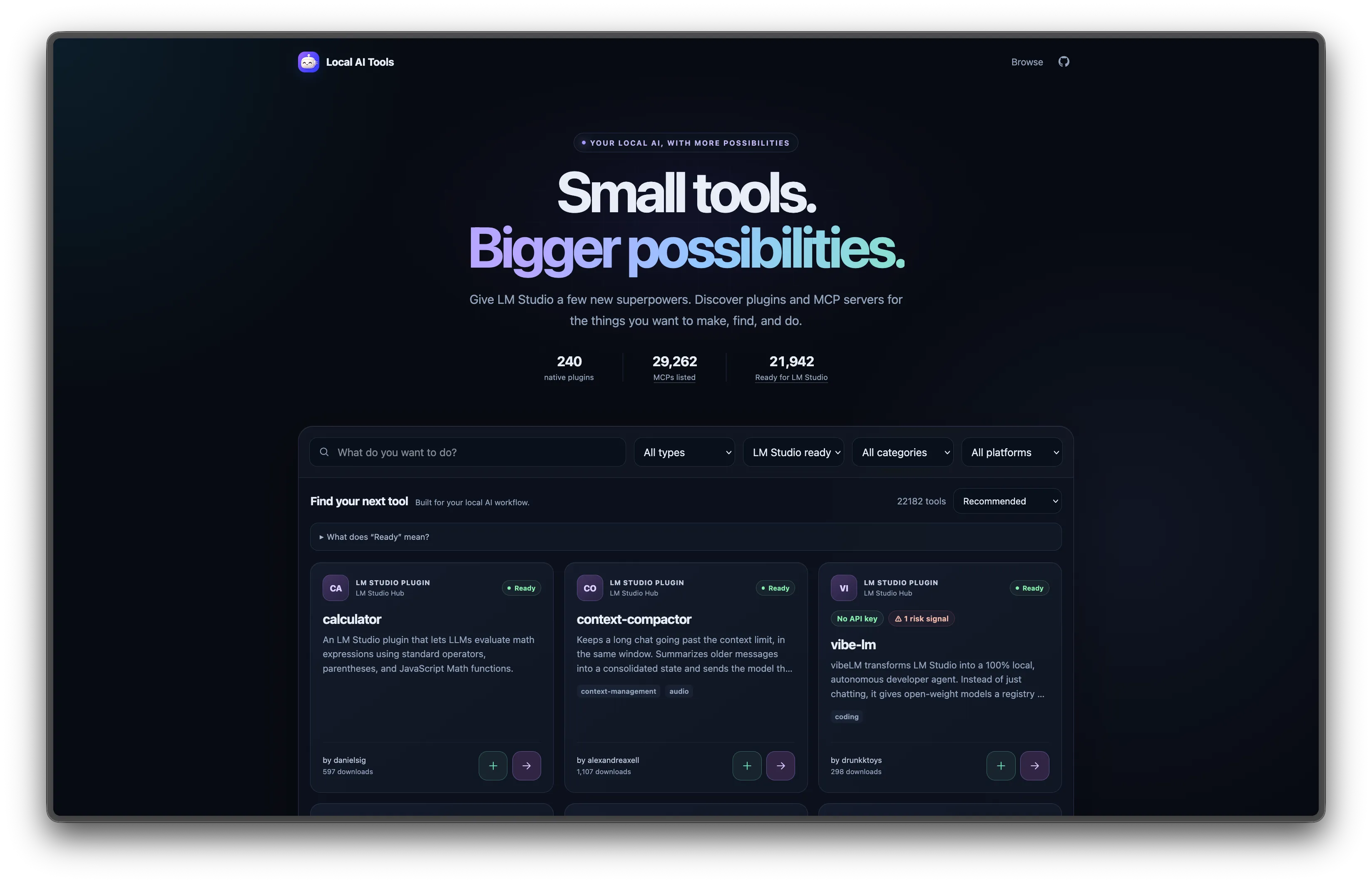
Try it with a video tool
Here’s a concrete example using Local Video Tools, a native plugin I also maintain. It exposes video inspection, trimming, conversion, and FFmpeg job management to LM Studio.
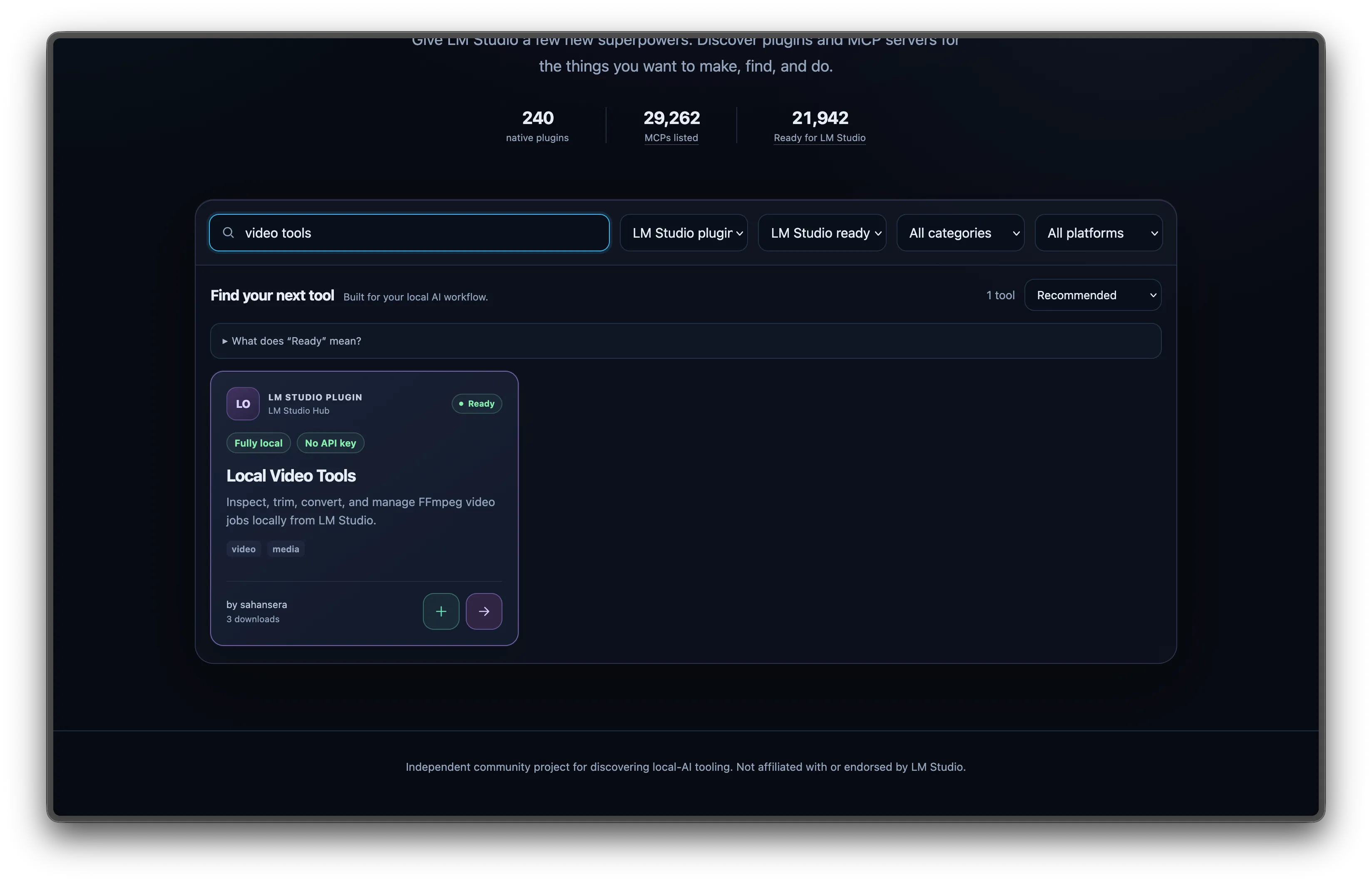
- Open Local AI Tools and select LM Studio plugins in the type filter.
- Search for
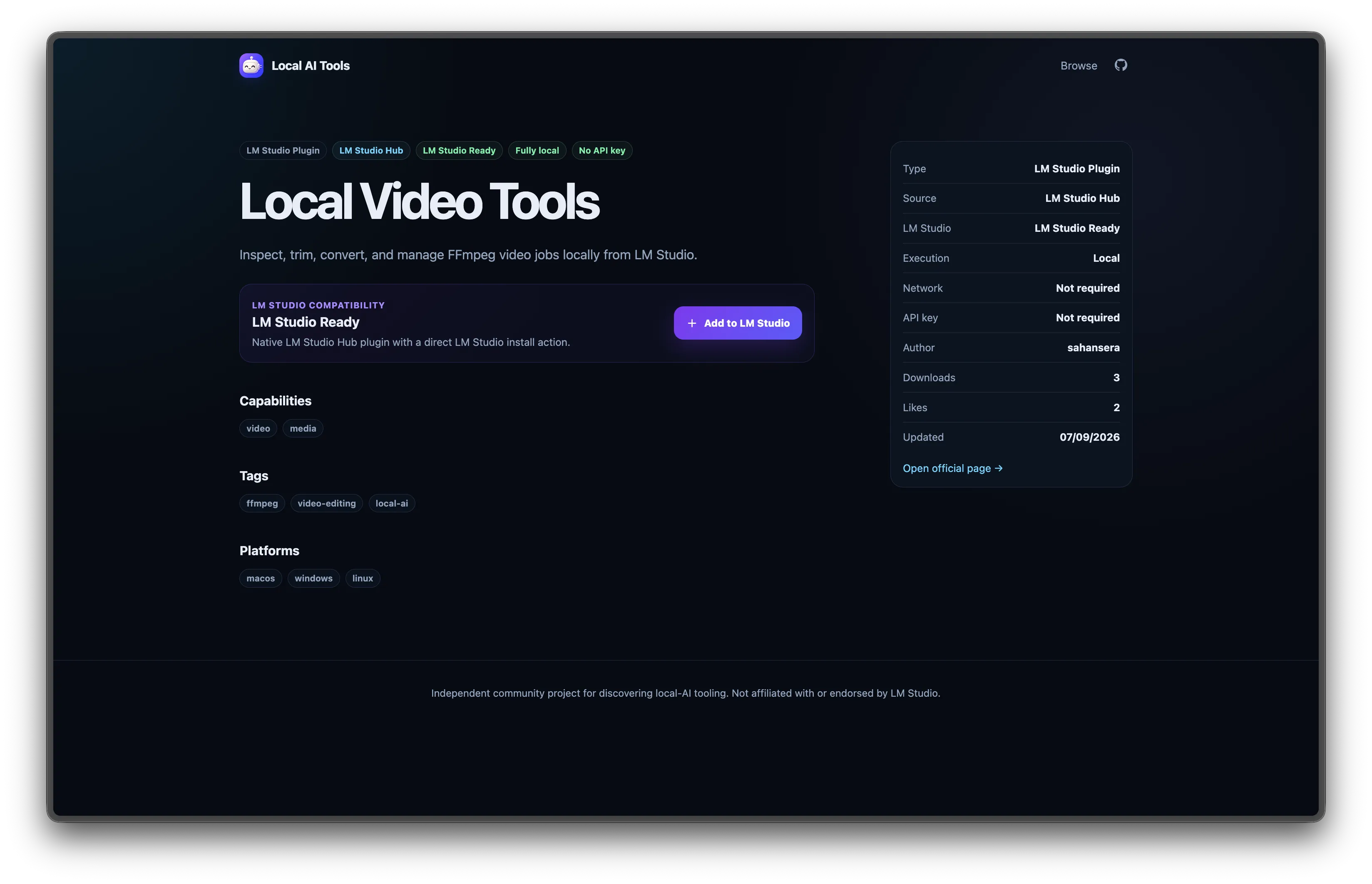
video. Look for Local Video Tools bysahansera; the author matters when similarly named tools appear. - Use the arrow to open its detail page. Check the description, runtime information, and upstream link.
- Read the plugin’s installation instructions. This one needs FFmpeg and ffprobe installed locally, even though it has a direct LM Studio installation link.
- With those requirements understood, use the + on its card or Add to LM Studio on the details page to open the installation flow in LM Studio.
The same browsing approach works for other capabilities: narrow the type, search for the task, and inspect a candidate. The directory gets you to the tool and its setup information; the upstream instructions explain how to finish configuring it.
This example also shows why “there’s an install button” and “everything is already set up” aren’t the same thing.
Native plugins and MCP servers have different setup paths
Native Hub plugins use LM Studio’s plugin installation links. Individual plugins can still depend on software installed on your machine, as the video example does.
MCP servers expose capabilities through the Model Context Protocol. LM Studio supports both local and remote MCP servers, with configuration supplied through mcp.json or an available Add to LM Studio link. The LM Studio MCP documentation explains those options.
For MCP listings, Local AI Tools checks whether the upstream metadata is sufficient to generate an LM Studio configuration. You’ll see three outcomes:
| Label | What it tells you | What to do next |
|---|---|---|
| LM Studio Ready | The metadata can produce a configuration without additional user-supplied values. | Review the source and runtime requirements before adding it. |
| Setup required | Additional values are needed, such as credentials, paths, or arguments. | Open the details and check which inputs you need to supply. |
| Compatibility unknown | There isn’t enough information to determine a configuration. | Check the upstream documentation for manual setup. |
The homepage initially filters for ready entries. Change the compatibility filter if you want to include tools that need setup or have unknown compatibility. An unknown label can reflect incomplete metadata, so it doesn’t by itself establish that the server is incompatible.
Check what will run, and where
A local model can use an integration that calls a remote service. An API key, network access, or filesystem access can therefore matter just as much as the tool’s name.
The directory surfaces runtime, API-key, source, and risk information where it’s available. Some metadata is inferred, and these signals aren’t a security audit. I haven’t tested every listed tool with every model. Check the upstream project when deciding whether to install it.
The practical distinction is between finding a tool, configuring it, and having your chosen model use it successfully. The catalogue helps with the first two. Actual behaviour still depends on the tool, its environment, and the model.
Open source, with room for better metadata
Local AI Tools is MIT-licensed and built with Astro. Discovery and enrichment happen during the build, and the site is published as static files. The source repository is linked with this article if you’d like to inspect the implementation or contribute.
Listed tools stay with their own maintainers and retain their own licenses. This is an independent community project, not affiliated with or endorsed by LM Studio.
The most useful contributions are concrete: a missing plugin, an incorrect category, or a setup requirement that a listing overlooks. Include the public tool link and what needs correcting in a GitHub issue.
Browse Local AI Tools and search for something you’d like your local model to do. You shouldn’t need to know the plugin’s name before you can find it.